

Losing most or all of your teeth affects more than appearance. It changes what you can eat, how clearly you speak, and over time, the structure of the jaw itself. For people in this situation, the options traditionally on offer, full dentures or partial dentures, do not always address those deeper concerns. Full mouth dental implants take a different approach, anchoring replacement teeth directly into the jawbone rather than resting on the gum surface.
For many people, the decision to explore full arch implant treatment involves weighing up the process, the timeline, and what the outcome may realistically look like for their particular situation. Understanding how the treatment works, who it may suit, and what factors shape the experience is a useful place to begin.
Quick Overview
- Full mouth dental implants are a fixed tooth replacement option that uses implants placed in the jawbone to support a full arch of replacement teeth
- May suit people who have lost most or all of their teeth, or who are living with failing teeth or unstable dentures, though suitability depends on individual bone and gum health
- Involves a staged surgical and restorative process that varies in complexity and duration depending on each person’s oral health
- Outcomes are influenced by bone density, gum condition, general health, healing response, and the number of implants required
- A thorough initial assessment, including 3D imaging and a review of medical and dental history, guides whether and how treatment may proceed
Keep reading to understand how full mouth dental implants work, what the process involves, and what to discuss with your dentist before moving forward.
What Are Full Mouth Dental Implants?
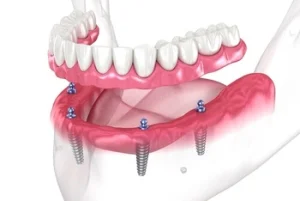 Full mouth dental implants are a tooth replacement approach that uses multiple implants placed into the jawbone to support either a fixed bridge or a full arch of replacement teeth. Unlike conventional dentures, which sit on the gum and rely on suction or adhesives for stability, implant-supported restorations are anchored to the bone directly.
The implants themselves are small titanium posts. Once placed, the jawbone fuses to each post, creating a stable foundation for the replacement teeth attached on top. This integration takes time, which is why treatment typically unfolds across several months rather than in a single appointment.
A full arch restoration does not necessarily require an implant for every missing tooth. Systems such as All-on-X use a smaller number of strategically positioned implants, often four to six, to support an entire row of replacement teeth. The exact approach, and the number of implants involved, depends on factors specific to each person’s jaw structure and bone volume.
Who May Be Suitable for Full Mouth Dental Implants?
Full mouth dental implants may suit a range of people, but they are not appropriate for everyone. A thorough clinical assessment is needed before any treatment decisions can be made.
People who may be considered for full mouth implant treatment include those who:
- Have lost most or all of their teeth in one or both arches
- Are living with failing, badly damaged, or heavily restored teeth that cannot be saved
- Find conventional dentures uncomfortable, unstable, or difficult to manage
- Have sufficient bone volume and density to support implant placement
Certain health and oral conditions can affect whether implant treatment is appropriate or require additional preparation before proceeding:
- Active gum disease: Advanced gum disease needs to be treated and stabilised before implants can be considered, as infection around the implant site increases the risk of failure
- Bone loss: When the jawbone has shrunk significantly from long-term tooth loss, additional preparation may be needed before implant placement can proceed
- General health factors: Conditions such as uncontrolled diabetes, or medications that affect bone metabolism, can influence healing and may need to be reviewed before treatment begins
- Smoking: Tobacco use is associated with higher rates of implant complications and may affect candidacy
None of these factors are automatic barriers. They are variables that a dentist will assess as part of an initial consultation to determine what may be achievable and what preparatory steps, if any, are needed.
How Does the Treatment Process Work?
Full mouth dental implant treatment is a staged process. The timeline and number of appointments vary depending on the complexity of each case, but the general sequence follows a consistent pattern.
 Initial assessment and planning: The first step involves a detailed examination of the teeth, gums, jawbone, and overall oral health. Digital X-rays and 3D CBCT imaging are used to map bone volume, nerve pathways, and the positions best suited for implant placement. Medical history is reviewed to identify any factors that may affect surgery or healing. A treatment plan is developed from this information.
Preparatory treatment (where needed): If existing teeth need to be extracted, or if gum disease requires treatment, this is addressed before implant surgery begins. Bone grafting, if required, typically adds several months to the timeline to allow the grafted material to integrate before implants can be placed.
Implant placement: The implants are placed into the jawbone in a surgical procedure carried out under local anaesthetic. IV sedation is available for people who prefer a more relaxed experience during treatment. After placement, a healing period follows during which the bone integrates with the implant surface. Temporary teeth are often provided during this phase so that function is maintained.
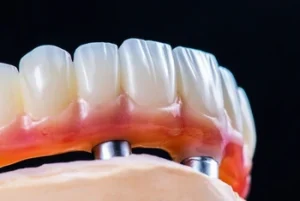
Restoration: Once healing is complete and the implants are confirmed stable, the final replacement teeth are attached. These are designed to match the natural appearance of the surrounding dental structures and are fitted to function comfortably for everyday eating and speaking.
Treatment unfolds in stages, with the duration depending on individual healing rates and the complexity of the case.
How Does Bone Health Affect the Process?
Bone health is one of the most significant factors in full mouth implant treatment. When teeth are lost, the jawbone beneath them gradually loses density and volume, a process that continues over time without stimulation from tooth roots. This is why conventional dentures, which do not interact with the bone, do not halt this progression.
Implants placed into the jawbone provide the stimulation that helps maintain bone volume over time. Unlike removable dentures, implants help preserve jaw bone after tooth loss by providing the stimulation the bone needs to remain stable.
When bone loss has already progressed significantly, bone grafting may be required to create sufficient volume for implant placement. The grafting procedure adds time to the treatment process and requires a separate healing period before implants can proceed. Not everyone who has experienced bone loss will require grafting; the extent and location of loss is assessed individually through 3D imaging.
Full Mouth Implants Compared to Conventional Dentures
Both options replace missing teeth, but they differ considerably in how they function and what they involve long-term.
Conventional dentures rest on the gum surface and may require adhesives for stability. They can shift during eating or speaking and do not interact with the underlying bone. Over time, as the jawbone continues to resorb, the fit of dentures typically changes, and they may require relining or replacement.
Full mouth implants are fixed in place and do not rely on the gum surface for retention. Because they are anchored in the bone, they do not move during normal function. Chewing ability is generally closer to that of natural teeth, and the bone stimulation provided by the implants supports jaw structure over time.
The trade-offs relate to the treatment process itself. Implants involve surgery, a staged timeline, and higher initial cost. Conventional dentures are non-surgical and more immediately accessible. Which option is more appropriate depends on a person’s oral health, bone condition, general health, and what they are hoping to achieve.
Caring for Full Mouth Dental Implants
Implant-supported restorations require regular care to remain healthy over time. While the replacement teeth themselves are not susceptible to decay, the gum tissue and bone around the implants can still be affected by bacterial build-up if oral hygiene is not maintained.
Recommended care includes:
- Brushing twice daily, paying attention to the gum line around each implant
- Using interdental brushes or a water flosser to clean between and around the implant components
- Avoiding habits that place excessive force on the restoration, such as chewing very hard foods or grinding
Daily cleaning of teeth, implants, and gums is a key part of maintaining oral health and protecting implants over the long term. Regular dental check-ups allow any early changes around the implant to be identified and managed before they develop into more significant problems.
A Considered Approach to Full Mouth Dental Implants in Paddington
 Full mouth dental implants involve a significant clinical process, and whether they are appropriate depends on a detailed picture of each person’s oral and general health. The treatment is not one-size-fits-all; the number of implants, the timeline, and the restoration design are shaped by individual circumstances.
At Red Hill Dental, the team uses 3D CBCT imaging and digital planning technology to assess each case with precision before any treatment begins.
To arrange a consultation, contact our Paddington team or call (07) 3368 3555.
Note: Any surgical or invasive procedure carries risks. Before proceeding, you should seek a second opinion from an appropriately qualified health practitioner.
Frequently Asked Questions
How long does full mouth dental implant treatment take?
The timeline varies depending on the complexity of each case. A straightforward treatment with no preparatory procedures may be completed within several months. Cases requiring tooth extractions, bone grafting, or gum disease treatment before implant placement can extend the process to twelve months or longer. A clear timeline is established after the initial assessment.
Can anyone get full mouth dental implants?
Not everyone is a suitable candidate. Factors such as insufficient bone volume, active gum disease, certain health conditions, and smoking can affect whether implants are appropriate or require additional preparation. A thorough clinical assessment, including 3D imaging and a review of medical and dental history, determines suitability on an individual basis.
References
Australian Dental Association. (n.d.). ‘Policy Statement 2.2.3 — Oral Hygiene’. Australian Dental Association. Sydney, NSW: Australian Dental Association. https://ada.org.au/policy-statement-2-2-3-oral-hygiene
Australian Dental Association. (n.d.). ‘Dental Implants’. Teeth.org.au. Sydney, NSW: Australian Dental Association. https://www.teeth.org.au/dental-implants
Better Health Channel. (n.d.). ‘Cosmetic Dentistry and Teeth Whitening’. Better Health Channel. Melbourne, VIC: Victorian Department of Health. https://www.betterhealth.vic.gov.au/health/conditionsandtreatments/cosmetic-dentistry-and-teeth-whitening
Healthdirect Australia. (n.d.). ‘Dental Implant’. Healthdirect Australia. Canberra, ACT: Australian Government. https://www.healthdirect.gov.au/dental-implant